

Hey! I finally did it! I created a purist Charlotte Mason schedule, tailored for whole-family learning. I have been working on this in all of my spare time and on two work days over the last two weeks. I am excited about this one! In this post, I will share a picture of the schedule, explain the amount of time spent per subject per form, and then I’ll share a pdf of the schedule at the bottom of this post.
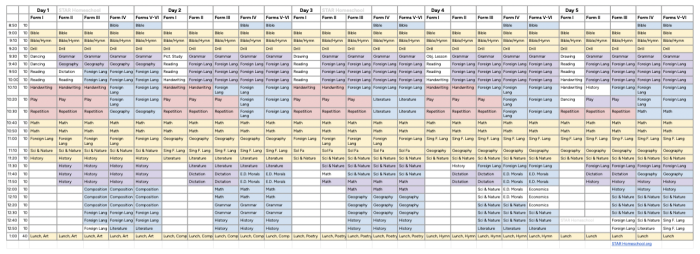
First, the picture of the 5-Day Schedule:
And of the 4-Day Version:
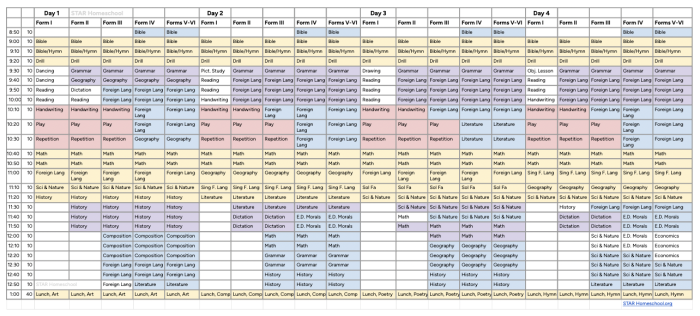
Aren’t these pretty? I made these schedules by setting my Charlotte Mason Timetable Cards out all over a table, rearranging, and then typing it all into a spreadsheet and rearranging some more to make it all fit together just right.
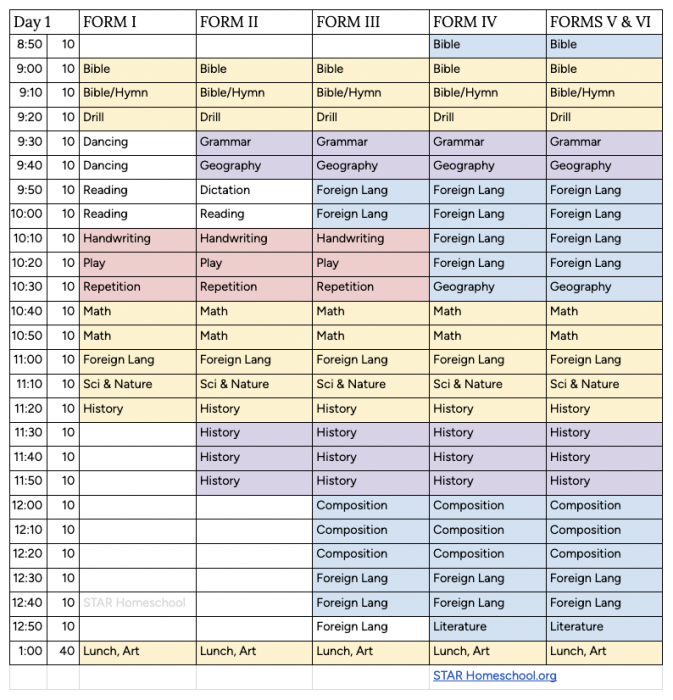
For the purposes of my spreadsheet, every block (except lunch) is in a 10 minute chunk. Older students will spend more than one block on most subjects, though. You might notice, for example, on Day 1 at 12 pm, that Forms III, IV and V-VI spend three blocks (10 min each) on Composition—that’s a 30 minute block.
The Goals
The P.U.S. timetables were created for a school setting, where children would be grouped by age (forms) into classrooms. I wanted to re-create the P.U.S. schedule for a family setting, but keep it as true-to the original as possible. What I mean is: I wanted students to spend just as much time on each subject (as if the P.U.S. school only met four or five days per week), and I didn’t want to add or take away from any subjects that are not on the original P.U.S. timetables.
I wanted to turn the P.U.S. timetable into a whole-family learning schedule. I am pleased to see how this turned out. Notice the colors on the picture above—these are all subjects that can be done at the same time with different grade levels.
Yellow = All Forms
Red = Forms I and II
Blue = Forms III, IV and/or V
Purple = Forms II, III, IV and/or V
I have tried this schedule in my home over the last two weeks, with students in forms III, IV, and VI, and I have adjusted the schedule multiple times because of my experience. You may wish to adjust it to fit your family, too. The Timetable Cards will help you, and the spreadsheet below will help, as well!
The Schedule, Broken Down into Days
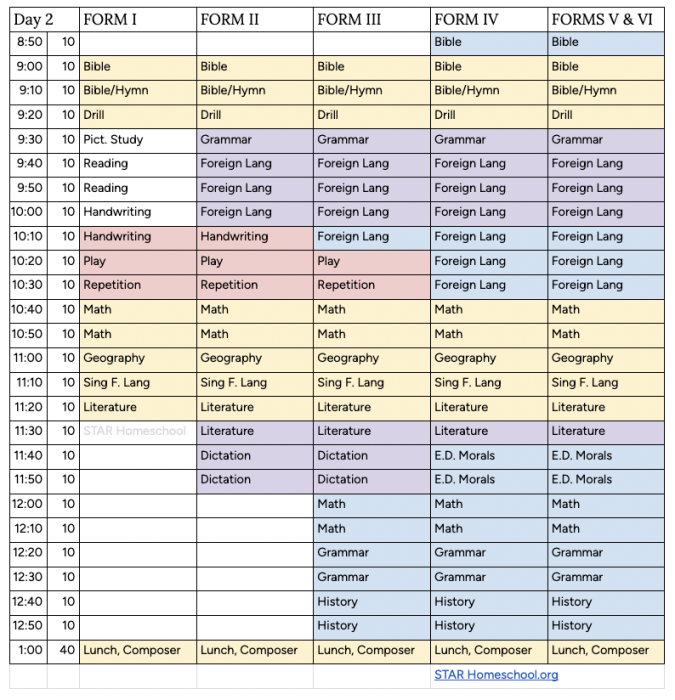
On the spreadsheet I created (below), there are tabs for each different day. This is what each of these tabs looks like:
Day 1
Day 2
Day 3
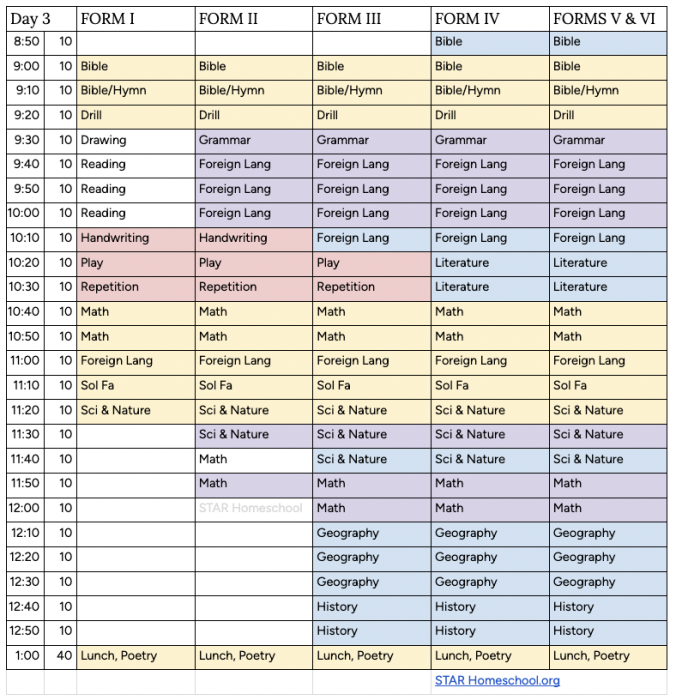
Day 4
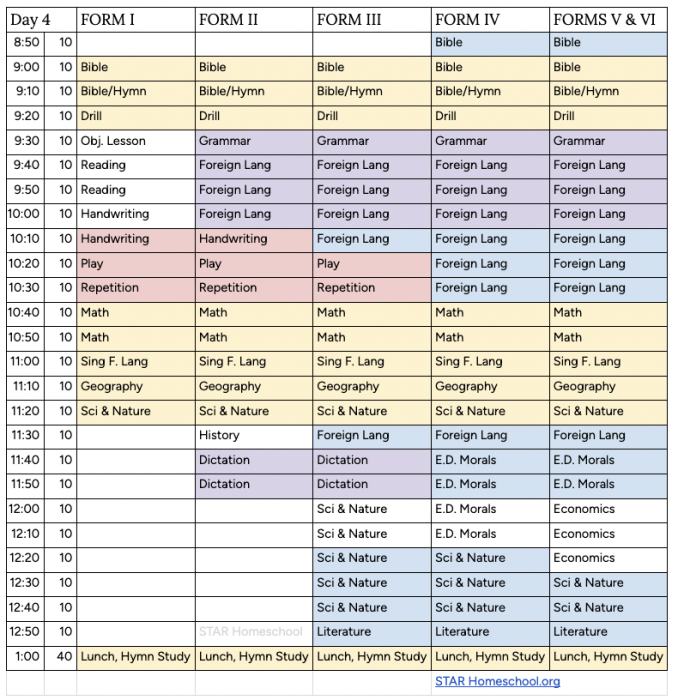
Day 5
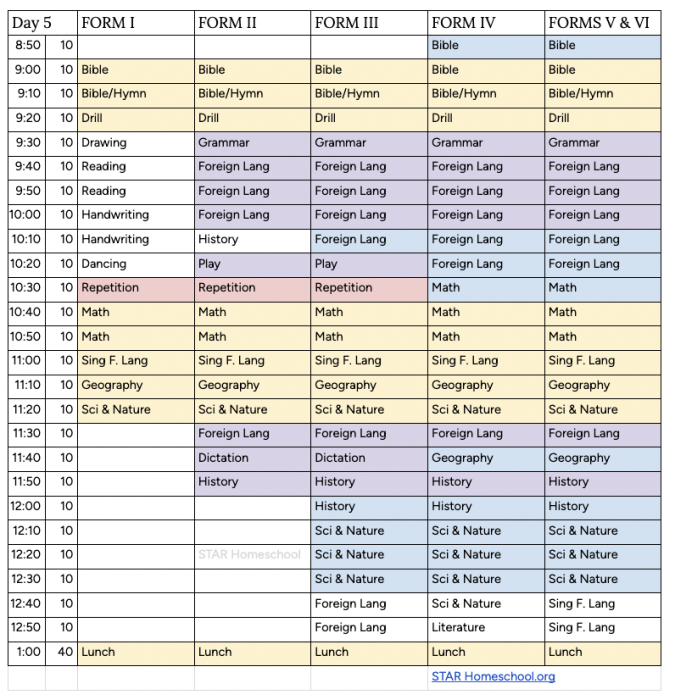
If you like this post, you’ll really enjoy being a subscriber! There’s a free option to see posts like this, and then there’s an inexpensive paid option, to get access to all of the reading plans I’ve made and the spreadsheets I have created. Subscribe here!Subscribed
The Schedule, Broken Down into Forms
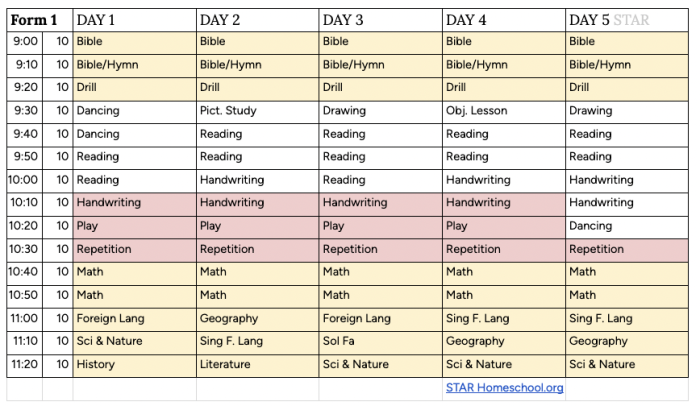
On the spreadsheet I created (below), there are tabs for each different form. This is what each of these tabs looks like:
Form I
(First-Third grades)
Form II
(Fourth-Sixth grades)
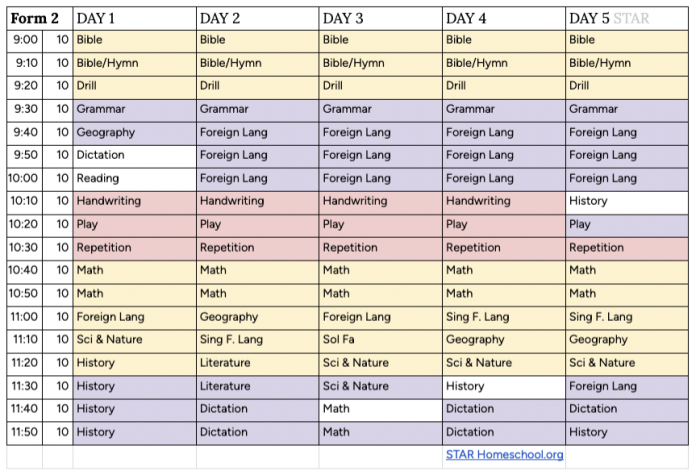
Form III
(Seventh-Eighth grades)
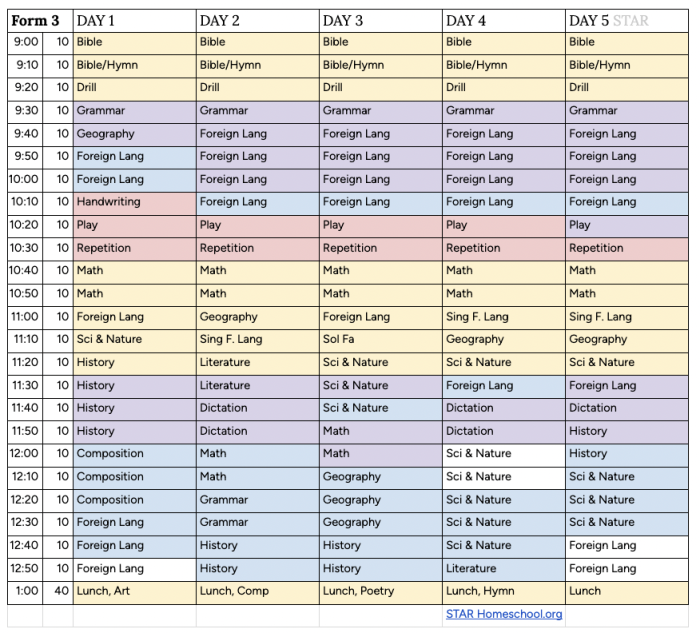
Form IV
(Ninth-Tenth grades)
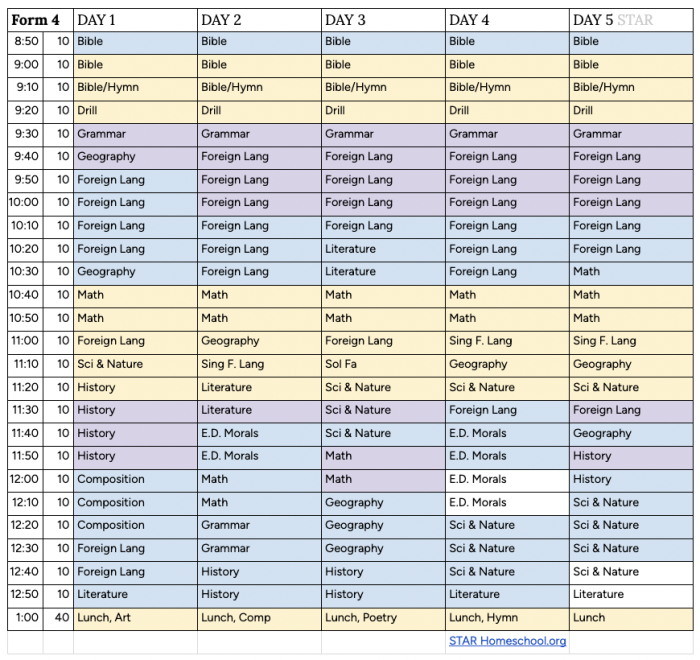
Forms V-VI
(Eleventh and Twelfth grades)
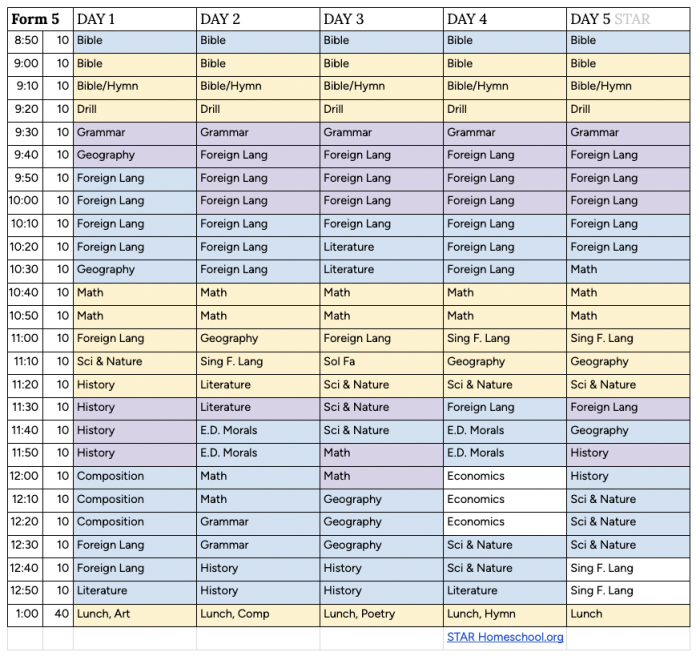
The Subjects & How Much Time is Spent
This is where the idea of a purist schedule comes into play. Let’s face it: true purist schedule would be identical to the P.U.S. timetables. Students would engage in educational endeavors six days per week, and the forms would engage in same or similar activities very little. To make this as pure as possible, though, while maintaining a whole-family learning environment, I paid attention to exactly how much time was spent on each subject.
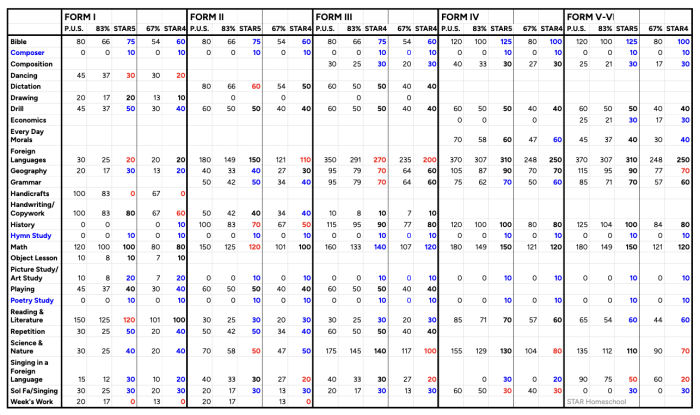
Below, you will see a table with:
- The amount of minutes the P.U.S. timetable included for each subject (P.U.S.) for each form
- What 83% of that time would be (5 days) (83%)
- How much time is included on STAR Five-Day schedule (STAR5)
- What 67% of the P.U.S. timetable time would be (4 days) (67%)
- How much time is included on the STAR Four-Day schedule (STAR4)
Numbers are red when too-few minutes are scheduled for the subject, and numbers are blue when there is an overage of minutes spent on the subject.
I personally love Hymn Study, Art/Picture Study, Composer Study and Poetry Study, and I believe that these subjects fit well with a Charlotte Mason schedule. I added ten minutes of each of these subjects to the 40-minutes allotted for lunch on days 1, 2, 3 and 4.
Below, you will find a brief explanation for each subject. This post will not include descriptions of each subject or what to do during each allotted slot for the subject. I may write (several!!) future posts about that.
Bible
I planned for 15 minutes per day of reading the Bible as a family, and then ten additional minutes every morning for Forms IV, V and VI. The STAR schedule allows for more Bible time than the original P.U.S. schedule.
Composer
The P.U.S. schedule does not have a designated time for studying a particular composer, but I have added this to lunch time on Day 2.
Composition
Forms III, IV, V, and VI spent some time on composition in the P.U.S. classroom, and I have added thirty minutes per week to this schedule.
Dancing
Form I is the only form with dancing scheduled, and I have scheduled it for twenty minutes (Day 1) on the four-day schedule, and an additional ten minutes on Day 5. This subject is red, because it’s about ten minutes short of ideal. If you’d like to add more dancing, feel free to do so!
Dictation
Only Forms II and III have Dictation scheduled on both the P.U.S. timetable and the STAR schedule. Form II should ideally have four extra minutes of Dictation on a four-day schedule and six extra minutes on a five-day schedule.
Drawing
Only Form I has Drawing scheduled, and just for 10-20 minutes per week.
Drill
Drill was scheduled for each of the forms, and is also scheduled for each of the forms on the STAR schedule. Form I has some extra Drill time on this schedule, because older forms needed more Drill time and it seemed like an appropriate whole-family subject.
Economics
Forms V-VI studied Economics in the P.U.S. classroom, and so do Form V-VI students who use the STAR schedule.
Every Day Morals
Forms IV, V, and VI studied a subject called Every Day Morals in the P.U.S. classroom, and I have added sixty minutes for Form IV and forty minutes for Forms V and VI to the STAR schedule.
Foreign Languages
Students in the P.U.S. classrooms spent a lot of time studying Foreign Languages! They spent far more time studying Foreign Languages than they did math! Starting in Form II, children studied three languages at a time, and then they studied four languages at a time beginning in Form III and up through high school.
Geography
All forms studied Geography in the P.U.S. classroom, and I have grouped together Geography studies two times during the four-day schedule and three times during the five-day schedule. Form III would have studied Geography about nine minutes more in the P.U.S. classroom and Forms V-VI would have studied it for about seven more minutes, so feel free to add a little extra Geography study for your Form III and V-VI students if you like.
Grammar
Students in Form II and up studied Grammar in the P.U.S. classrooms, and are scheduled study Grammar on the STAR schedule as well. Form III students are short on Grammar by about nine minutes on the STAR schedule.
Handicrafts
Form I students had handicrafts scheduled during the school day in the P.U.S. classrooms, and before 11:30 am. I have not scheduled Handicrafts on the STAR schedule, because if I did so, I would not have been able to schedule all of the wonderful whole-family subjects. You may fill in Handicrafts as often as you like, or choose to do them in the afternoon.
Handwriting/Copywork
This subject was scheduled for students in Forms I, II and III, and can also be found on the STAR schedule for these forms.
History
Students studied history beginning in Form II, and up through high school. I did schedule this subject for ten minutes for the whole-family, so Form I students will get a little exposure to History on the STAR schedule. Form II students are thirteen to seventeen minutes short on history on the STAR schedule, compared to the P.U.S. schedule. I was thinking, this could be solved by having a Form II student read some historic fiction before bed time one night per week.
Hymn Study
Hymn study was not included on the original P.U.S. timetable, but I have added ten minutes of hymn study during the lunch time slot on Day 4.
Hymns
See Sol Fa.
Math
Math is scheduled all at one time, but I realize that each student may be at very different levels. You may wish to change this scheduling in order to help each student at their own level. Or, maybe you prefer to have your “math brain” on all at once and to answer all math-related questions in a short period of time.
Object Lesson
This is scheduled for Form I students, and just for ten minutes per week.
Picture Study (Art)
Form I is the only form that is scheduled for Picture Study on the P.U.S. schedule. I have included ten minutes of individual Picture Study. And then, I have also scheduled ten minutes during the lunch slot on Day 1 with the whole family.
Playing
In addition to Handicrafts, the P.U.S. timetable included Play time for students in Forms I, II and III. In my original version of this schedule, I did not include Play time at all. I decided to start including it, and testing it on the Form III student I am teaching, and it helps! I have included ten minutes of play each day, except on Day 5, when Form I students spend time Dancing, and Form II and III students engage in Play. If you have students in each of these forms, perhaps you will want to group them together and choose one activity or the other—Play—or Dance.
Reading/Literature
I’ve grouped together Reading and Literature, but these are listed as two different subjects on the P.U.S. and STAR schedules. I assume that students in the Form I classroom (who spent a lot more time on Reading than the older kids) were spending time actually learning to read, as well as practicing the skill. Older students would have spent time reading Literature, though not nearly enough time, in my opinion! I’ve scheduled ten minutes of whole-family Literature time on Day 2, as well as additional Literature time during the week for Forms II-VI.
Repetition
Forms I, II and III spent time on Repetition of a variety of subjects. I’ve included this time on the GLC schedule, as well.
Science & Nature
While the Science & Nature subjects were laid out specifically on the P.U.S. schedule, I don’t think it hurts to read a Nature Study book aloud to all of your children at once, for at least part of their Science & Nature time. Students spend three to four ten-minute segments all together for Science & Nature, and then students in Form II and up have more Science & Nature time scheduled.
Singing in a Foreign Language
All students in the P.U.S. classes sang songs in foreign languages. I have grouped students together for twenty minutes (on the four-day schedule) and thirty minutes (on the five-day schedule) to sing together. Students in Forms V and VI spent longer on this subject, and, ideally, would spend 25 (five-day schedule) to 40 (four-day schedule) more minutes on this subject.
Sol Fa/Singing
I’ve included Hymn singing as part of Sol Fa/Singing, and I have scheduled it for five minutes every morning, along with Bible time. In addition, I added Sol Fa to the schedule on Day 3.
Week’s Work
This was scheduled for students in Forms I and II on the P.U.S. timetable, but I have not included it on the STAR schedule at this time.
I hope you have enjoyed this!
Please comment below to let me know what you think of this! If you adjust this to fit your family’s needs, let me know how you changed it. In what ways would you improve upon this schedule? Tell me below!
2 thoughts on “A Charlotte Mason Schedule for “Purists””